
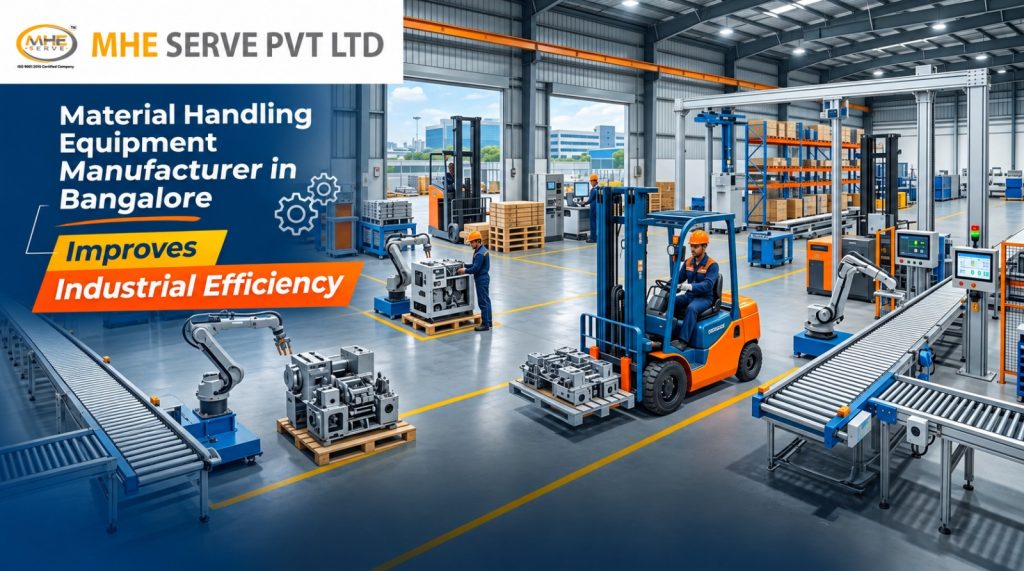
Walk through any busy factory or distribution centre and you will notice that the product itself is rarely what slows things down. The delays happen in between: a pallet waiting for a forklift, cartons carried by hand across a packing area, a truck held at the dock while it is unloaded piece by piece. How smoothly materials move decides how smoothly everything else runs.
That is why a material handling equipment manufacturer in Bangalore plays a practical role for the city’s industries. Bengaluru’s manufacturing units, warehouses and logistics operations all depend on moving goods safely, quickly and with as little manual effort as possible. MHE Serve Pvt. Ltd., based in the Attibele Industrial Area, builds material handling equipment for exactly these needs. This article explains how the right equipment improves industrial efficiency and what to consider when choosing it.
Understanding Industrial Material Handling Equipment
Industrial material handling equipment covers the machines and systems that move, lift, stack, store and load goods inside a facility. It includes simple devices like hand pallet trucks and complex ones like powered conveyor lines and enclosed goods lifts. The purpose is the same across all of them: to move materials between receiving, storage, production, packing and dispatch without wasting time, effort or product.
In a manufacturing plant, this means getting raw materials to workstations and finished goods to packing. In a warehouse, it means putting stock away, retrieving it and loading it onto vehicles. In a logistics centre, it means keeping inbound and outbound flows moving at the dock. Equipment designed around these tasks lets people do less lifting and carrying, and more supervising and coordinating.
How Material Handling Equipment Improves Industrial Efficiency
Less Manual Handling, Better Ergonomics
Repeated lifting, bending and carrying tire workers raises the risk of injury and product damage. Pallet trucks, stackers, lift tables and conveyors take over the heaviest and most repetitive movements. This is ergonomic material handling in practice: the machine carries the load, and the operator guides it.
Faster, More Predictable Movement
When goods travel by conveyor or powered truck instead of by hand, movement times become more consistent. Production lines are fed on schedule, and staging areas stop filling up with material waiting to be moved. That steadier rhythm also helps different departments coordinate with each other.
Better Use of Space
Stacking and lifting equipment lets facilities use vertical space instead of spreading stock across the floor. Compact equipment that turns in tight aisles also helps teams work within the layout they already have, which matters in space-constrained industrial units.
Safer, More Organised Operations
Defined handling routes, equipment with safety features, and fewer manual lifts all contribute to a more orderly workplace. When people and materials move along planned paths, congestion, near-misses and product damage tend to fall.
Material Handling Solutions for Different Industrial Requirements
No single machine solves every handling problem. Most facilities combine several categories, each suited to a particular type of movement.
Horizontal Transportation Systems
Horizontal transportation is the movement of goods across the same level, from a receiving bay to a storage zone or from one production area to the next. Horizontal transportation equipment includes hand pallet trucks, weighing pallet trucks, paper roll pallet trucks, rough terrain trucks and high lift pallet trucks. Each addresses a different load or floor condition, from palletised cartons to paper rolls to uneven surfaces. For short, frequent moves inside a plant, this is usually the first category worth reviewing.
Stacking and De-stacking Equipment
Stacking is about lifting and placing loads at height, and de-stacking is about bringing them back down. MHE Serve’s stacking and order picking range includes manual stackers for short-distance in-plant lifting, semi-electric stackers for more intensive stacking, and fully electric stackers suited to narrow aisles and busy gangways. It also includes furnace loaders, which can be customized for specific load sizes and application needs. Choosing between these depends on how often loads are lifted, how high they go and how far they travel.
Loading and Unloading Equipment
The dock is where many facilities lose time. Loading and unloading equipment such as dock levellers bridges the gap between truck and floor. The hydraulic mobile dock ramp (MDR 10) lets a forklift drive into a container, which reduces manual effort and product damage. Scissor lift tables raise goods to a convenient working height, and order pickers make retrieval from racking easier. Together, these improve loading bay efficiency and shorten truck turnaround.
Hydraulic Goods Lifts
When material has to move between floors, a good lift is often the practical answer. A hydraulic goods lift transports heavy goods vertically in warehouses, factories and storage facilities. MHE Serve’s lifts come with options such as enclosed cabins, collapsible safety gates, PLC panels and a weighing scale attachment, so the configuration can follow the building and the application. This vertical movement complements the horizontal equipment on each floor.
Industrial Conveyor Systems
Conveyors move goods continuously along a fixed path, which is why they are central to production and packing lines. MHE Serve’s conveyor range includes PVC belt, modular, inclined belt, gravity roller and motorized roller conveyors, along with flexible extendable roller conveyors and truck-loading belt conveyors with an operator platform.
The Role of Industrial Conveyor Systems
Industrial conveyor systems matter because they turn scattered, manual movement into a steady flow. On a production line, a conveyor carries components from station to station, so operators do not leave their position to fetch materials. In packaging areas, it moves finished products toward labelling, packing and palletising. In warehouses and dispatch zones, it carries cartons from sorting areas to loading points.
Different conveyors suit different jobs. Gravity roller conveyors work where loads can move under their own weight, while motorized roller and belt conveyors provide controlled, powered movement. Inclined belt conveyors carry goods to a different height. Extendable conveyors are useful for temporary lines and flexible loading and unloading, and truck-loading conveyors help with moving goods in and out of vehicles. The right choice depends on what is being moved, how it is packed, and where the line runs.
Warehouse Material Handling Solutions for Better Productivity
Effective warehouse material handling solutions start with layout and flow. Goods should travel the shortest sensible path from receiving to storage to dispatch, without crossing other flows or doubling back. Equipment is then matched to each stage.
- Receiving and dispatch: dock levellers, mobile dock ramps and truck-loading conveyors keep loading zones moving.
- Storage and stacking: stackers and order pickers improve access to stored goods and make better use of height.
- Movement between areas: pallet trucks and conveyors link receiving, storage, packing and dispatch.
- Movement between floors: goods lifts connect levels without clogging staircases or manual routes.
Storage accessibility deserves attention too. If frequently picked items are hard to reach, picking slows down no matter how good the equipment is. Reviewing which items move most often, and placing them within easy reach of the right equipment, often brings gains before any major investment.
Why Choosing the Right Material Handling Equipment Supplier in Bangalore Matters
Equipment that looks suitable on paper can still disappoint on the floor. Choosing the right material handling equipment supplier in Bangalore means looking beyond a product list.
- Application assessment: A good supplier asks about your loads, distances, floor conditions, shift patterns and building layout before recommending anything.
- Equipment suitability: Narrow aisles, uneven surfaces, multi-storey buildings and frequent truck movements each call for different equipment.
- Engineering knowledge: Customisation, such as fork dimensions, lift heights or lift configurations, requires a team that understands how equipment behaves in real use.
- Dependable solutions: Industrial equipment runs for long hours, so build quality and safety features matter more than the lowest price.
- Long-term considerations: Think about maintenance, spare parts, and how your operations may grow. Equipment should still fit your needs after the first year.
A manufacturer based in the same region also makes it easier to discuss requirements, review options and follow up after installation.
How MHE Serve Supports Industrial Material Handling Requirements
MHE Serve works across the main categories of in-plant and warehouse movement: horizontal transportation, stacking and order picking, loading and unloading, hydraulic goods lifts and conveyors. That breadth lets a facility look at its handling needs as a connected system instead of buying one machine at a time.
A food packing unit might need conveyors for its line and pallet trucks for dispatch. A distribution centre might need stackers, order pickers and dock equipment. A multi-storey factory might need goods lifts plus horizontal transport on each level. Browsing the full material handling equipment solutions shows how these categories fit together. From there, the team can be contacted to discuss which combination suits a specific facility.
Conclusion
Efficient material handling is less about any single machine and more about how well movement, lifting, stacking, loading and storage work together. The right equipment reduces manual effort, keeps goods flowing and makes better use of space. Working with an experienced material handling equipment manufacturer in Bangalore helps you match each of those needs to equipment that fits your operation.
If you are reviewing your plant, warehouse or dock, start by mapping where materials slow down, then explore MHE Serve’s range of material handling solutions. Contact the team to discuss your requirements.
