
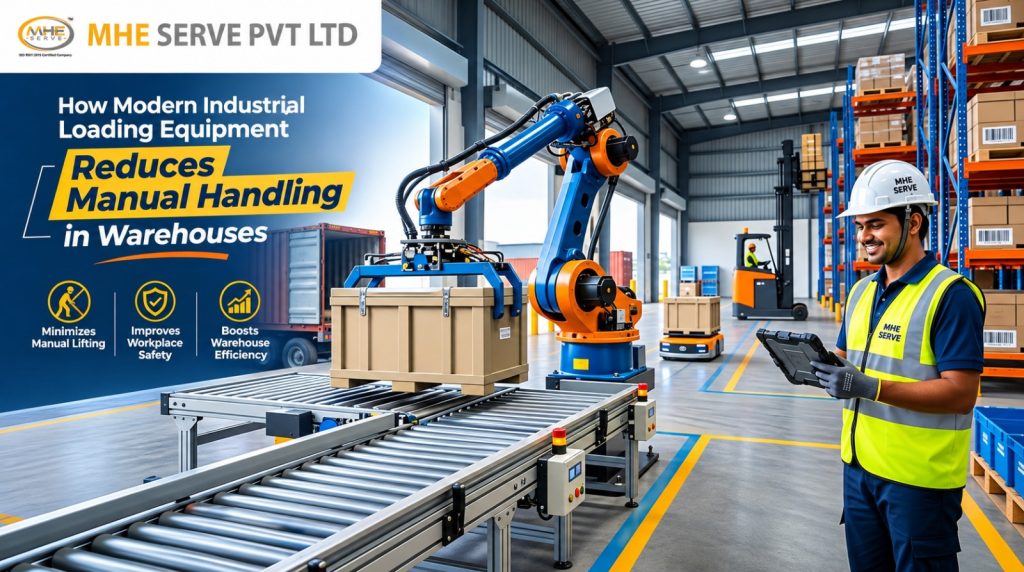
Every warehouse runs on a simple rhythm: goods arrive, move, get stored, are picked and leave again. The loading dock is where that rhythm is most often broken. When cartons, sacks, drums and pallets are lifted by hand off a truck bed, even a well-planned operation slows down, and the people doing the lifting carry the cost.
Industrial loading equipment changes that equation. Instead of repeated bending, lifting and carrying, facilities can use dock levellers, mobile dock ramps, scissor lift tables, truck loading conveyors and goods lifts to move material with far less physical effort. For businesses that depend on steady throughput, the move from manual to mechanised handling is less about technology and more about safer shifts, predictable schedules and fewer bottlenecks.
This guide explains where manual handling goes wrong, how modern warehouse loading and unloading solutions address it, which equipment suits which task, and what to check before choosing industrial material handling solutions for your site.
Understanding Manual Material Handling Challenges
Manual handling feels flexible because people can adapt to almost any load. The problems appear over time.
Physical strain and injury risk
Repeated lifting, twisting and awkward postures stress backs, shoulders and knees. Heavy or irregular loads, lifting from floor level, and moving goods across the height gap between a dock and a truck bed all raise the risk of strain, slips and falls. Every injury means lost shifts and unplanned replacement labour.
Delays and labour dependency
A manual unloading routine depends on how many people are available and how tired they are. When a truck arrives early or a shift is short-staffed, dock queues grow, and put-away, picking and dispatch all wait behind them.
Inconsistent movement and product damage
Hand-carried goods get dropped, stacked unevenly or dragged across surfaces. Throughput also varies from one crew to the next, which makes it hard to plan dock schedules or promise delivery windows. These inefficiencies rarely show up as one large failure; they accumulate as minutes lost on every truck.
How Modern Industrial Loading Equipment Reduces Manual Handling
The most useful industrial loading equipment removes the hardest part of the task instead of simply speeding it up.
- Bridging the dock gap. A dock leveller closes the height difference between the dock and the truck bed, so a forklift or pallet truck can drive across rather than staff lifting loads over the edge.
- Taking the forklift into the vehicle. A mobile dock ramp lets a forklift enter a container or truck and place palletised cargo directly, which cuts the number of items carried by hand.
- Lifting loads to working height. Scissor lift tables raise materials to a comfortable level, reducing bending and overreaching.
- Moving goods continuously. Truck loading conveyors carry cartons and bags along a set path, so operators guide the flow instead of carrying each piece.
- Moving between floors. Goods lifts transport heavy items vertically, replacing stair carrying and manual trolley hauling.
The result is a different kind of work. Operators position, check and supervise rather than lift and carry, and each truck follows the same repeatable sequence. That consistency is what makes dock planning possible.
What this looks like in practice
In a warehouse, a dock leveller and a pallet truck let a crew unload palletised stock without manually lifting anything across the gap. In a manufacturing plant, a goods lift carries raw material to an upper floor while a scissor lift table presents it to a machine at working height. In a logistics hub handling cartons and bags, a portable truck loading conveyor moves parcels from the vehicle into the sorting area, with operators guiding rather than carrying. In each case the equipment is chosen for the task, not the other way round.
Types of Warehouse Loading Equipment
The right mix depends on what you move and where. The categories below reflect equipment that MHE Serve manufactures.
Dock levellers and hydraulic mobile dock ramps
MHE Serve’s Loading and Unloading Equipment range includes edge-of-dock levellers, which suit docks and truck beds at close to the same height. The listed operating range is about 5 inches above and below deck, with rubber bumpers to protect the dock face. The hydraulic MDR 10 mobile dock ramp is designed for container and truck loading: a hydraulic cylinder aligns its height with the vehicle, floor locks add safety, and the ramp can be moved away once the job is finished.
Scissor lift tables
Available in single, double, twin, tandem and mobile versions, scissor lift tables raise loads to a convenient height for transfer. A mobile version rated for up to 1,000 kg with a lift height of up to 1,600 mm is used for moving dies, boxes and similar items to and from machines or small trucks.
Conveyor-based material transfer
Where goods move in volume, Industrial Conveyor Systems reduce carrying. The range includes PVC belt, modular, inclined belt, gravity roller and motorised roller conveyors, along with flexible extendable roller conveyors and a portable, adjustable truck loading belt conveyor for loading and unloading vehicles.
Goods lifts and vertical transportation
Hydraulic Goods Lift Solutions move heavy goods between floors in warehouses, factories and storage facilities. MHE Serve offers hydraulic and hoist-type goods lifts, with features such as an enclosed cabin, collapsible safety gates and PLC panels, plus FLP and stainless steel (SS) options.
Supporting material handling equipment
Loading is only one stage of the flow. Within the site, Horizontal Transportation Systems such as hand pallet trucks, high-lift pallet trucks and rough terrain trucks move loads across a level, while Industrial Stacking and De-stacking Solutions including manual, semi-electric and fully electric stackers, order pickers and furnace loaders position them in racks or at height.
Benefits of Industrial Loading Equipment in Warehouses
When loading equipment replaces repetitive lifting, the gains show up in several places:
- Worker safety. Less lifting, bending and carrying reduces exposure to strain, and features such as overload protection, safety stands and floor locks add protection during operation.
- Productivity. Trucks are turned around by a repeatable process rather than by whoever happens to be on shift, which shortens dock queues.
- Space use. Goods lifts use vertical space, and a mobile dock ramp can be moved aside after loading to free the bay.
- Consistent material flow. Conveyors and levellers keep goods moving at a steady pace between vehicle, floor and storage.
- Lower manual workload. Staff can be redeployed to inspection, sorting and inventory accuracy, where judgement matters more than strength.
- Better workflow management. With predictable dock cycles, supervisors can schedule trucks, labour and put-away more reliably.
How to Select the Right Warehouse Loading Equipment
A short checklist avoids most mismatches.
Material and load characteristics
Weight, dimensions, packaging and fragility decide whether you need pallet-capable equipment, a conveyor or a lift. Check the rated capacity against your heaviest load, not the average one.
Warehouse layout and loading dock requirements
Measure dock height, truck bed height, floor space and headroom. Edge levellers suit similar heights, while a mobile dock ramp offers flexibility because it can be relocated once the job is done.
Movement frequency
A few trucks a day and a continuous stream call for different solutions. Higher frequency usually justifies powered or continuous equipment such as conveyors, while lower volumes may be served well by a simpler unit.
Compatibility, maintenance and support
Check that new equipment works with the forklifts, pallets and racking you already use. Ask about power requirements, routine maintenance, safety features and spare parts support, because equipment that is hard to service quickly becomes a bottleneck itself.
The Role of MHE Serve in Industrial Material Handling
MHE Serve Pvt. Ltd. is a material handling equipment manufacturer based in Attibele Industrial Area, Bengaluru, serving warehouses, factories and logistics centres. For businesses searching for material handling equipment in Bangalore, its Material Handling Equipment Solutions cover five categories: horizontal transportation, stacking and order picking, loading and unloading, goods lifts and conveyors.
Because the equipment is manufactured in-house, options such as lift heights, fork sizes or flameproof electricals can be discussed against your application. A practical starting point for a site with a loading bottleneck is to share your load type, dock arrangement and daily truck volume, and ask which combination of levellers, ramps, conveyors and lifts fits.
Conclusion
Manual handling will always have a role, but it should not be the default way to move heavy, repetitive loads. Modern industrial loading equipment shortens loading cycles, lowers physical strain and gives warehouses a steadier flow from dock to storage. If your team still lifts by hand at the dock, review one truck cycle step by step and note where loads are lifted, carried or waited on; those steps show where equipment will help most. To explore options, visit MHE Serve or contact the team to discuss your requirements.
